About Street Light Poles: The Foundation of a Street Light
A solar light is only as good as the pole holding it up. Here's what separates a pole built to last from one that isn't — steel grade, EPA, galvanization, and foundation depth.
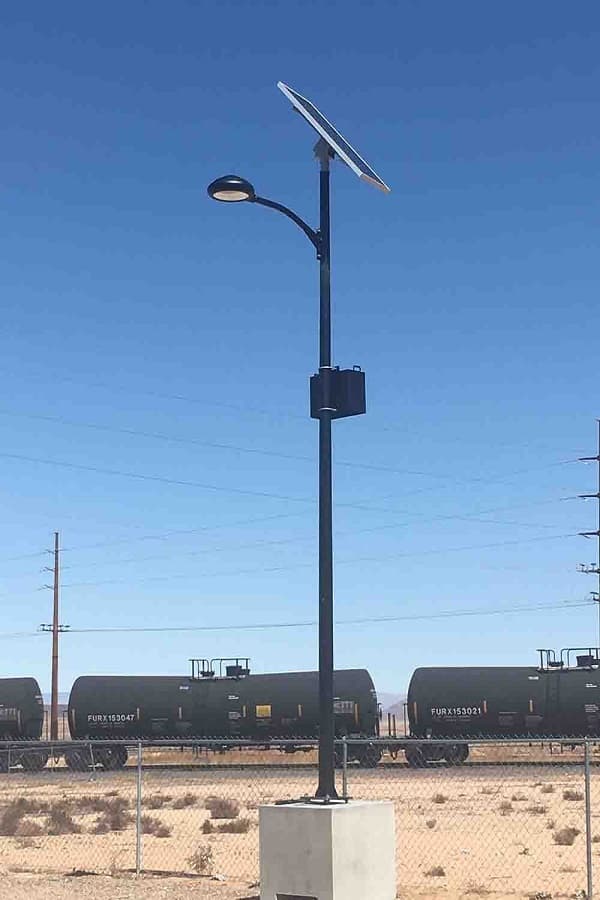
A solar light is only as good as the pole holding it up, and pole quality is one of the most overlooked factors in a lighting project — right up until a pole fails and takes the fixture down with it. Here's what actually separates a pole built to last from one that isn't, starting with the material.
Why Steel Beats Aluminum for Street Light Poles
Steel outperforms aluminum for street light poles for one main reason: vibration resistance. Poles experience two kinds of vibration over their lifespan — first-mode vibration, the ordinary sway caused by everyday wind, and second-mode (Aeolian) vibration, a more destructive, higher-velocity effect that can crack a pole's mid-section over time. Aluminum holds up far worse than steel under Aeolian vibration, and it's also more prone to warping under the sustained heat exposure a pole mounted with solar equipment sits through every day.
Steel Standards That Matter
Quality solar street light poles are built to recognized steel standards — Q235 in China or ASTM-GR65 in the U.S. Q235 is a carbon-heavy steel commonly used in bridge construction, with the "Q" referring to a yield point of 235 megapascals. Manufacturers who cut corners on steel grade are cutting into the one property — structural strength — that a pole can't compensate for anywhere else in the system.
Sizing: Effective Projected Area
Every pole has to be engineered around its Effective Projected Area (EPA) — the calculation of force a pole will experience from wind and the weight of its fixture and solar components combined. A qualified structural engineer has to sign off on EPA calculations before installation; get it wrong, and the pole can fail under a load it was never actually rated to carry. Standard street light poles typically run 25 to 30 feet, while pathway poles are shorter, in the 12- to 20-foot range.
Finishing: Galvanization and Powder Coating
| Process | What It Does | Why It Matters |
|---|---|---|
| Hot-dip galvanization | Dips the pole in zinc heated to roughly 840°F, forming a chemical zinc carbonate bond | Far more durable rust protection than cold-dip galvanization's painted-on zinc layer |
| Cold-dip galvanization | Paints the pole with a zinc-based coating | A weaker, mechanical bond that wears off faster from weather and abrasion |
| Powder coating | Electrostatically applies a durable finish coat | Avoids the volatile organic compounds (VOCs) released by other finishing methods |
The Foundation Underneath It All
None of the pole quality above matters if the foundation beneath it is wrong. A solar light pole needs a concrete pedestal poured and fully cured before the pole goes up — typically at least 4 feet deep, and sometimes 6 feet deep depending on pole length and EPA. Skimping on foundation depth is one of the more common — and more dangerous — shortcuts taken on lighting projects that weren't engineered properly from the start.
Conclusion
A street light pole doesn't get much attention until it fails, but the right steel grade, a properly calculated EPA, hot-dip galvanization, powder coating, and an adequately deep foundation are what let a solar light pole outlast every other component of the system it's holding up. Cutting a corner on any one of them is the fastest way to end up replacing a pole years before its rated lifespan.
Professional Consultation
Fill in your project details and one of our lighting experts will get back to you within 24 hours.
Questions? Call us at 949-609-9636
Financing Available
Greenshine partnered with Balboa Capital, a top-rated direct lender, to offer fast, easy, and affordable equipment financing options.
Learn more →Related Articles
Solar Light Fixture 101
Cobra head, decorative, bollard, all-in-one — here are the common solar light fixture styles and what protects them from the weather.
Solar Lighting Design Guide: Sizing, Aesthetics, and More
Sizing, layout, aesthetics, and Dark Sky compliance all have to be solved together for a solar lighting design to actually work. Here's how it's done.