Solar Lighting Design Guide: Sizing, Aesthetics, and More
Sizing, layout, aesthetics, and Dark Sky compliance all have to be solved together for a solar lighting design to actually work. Here's how it's done.
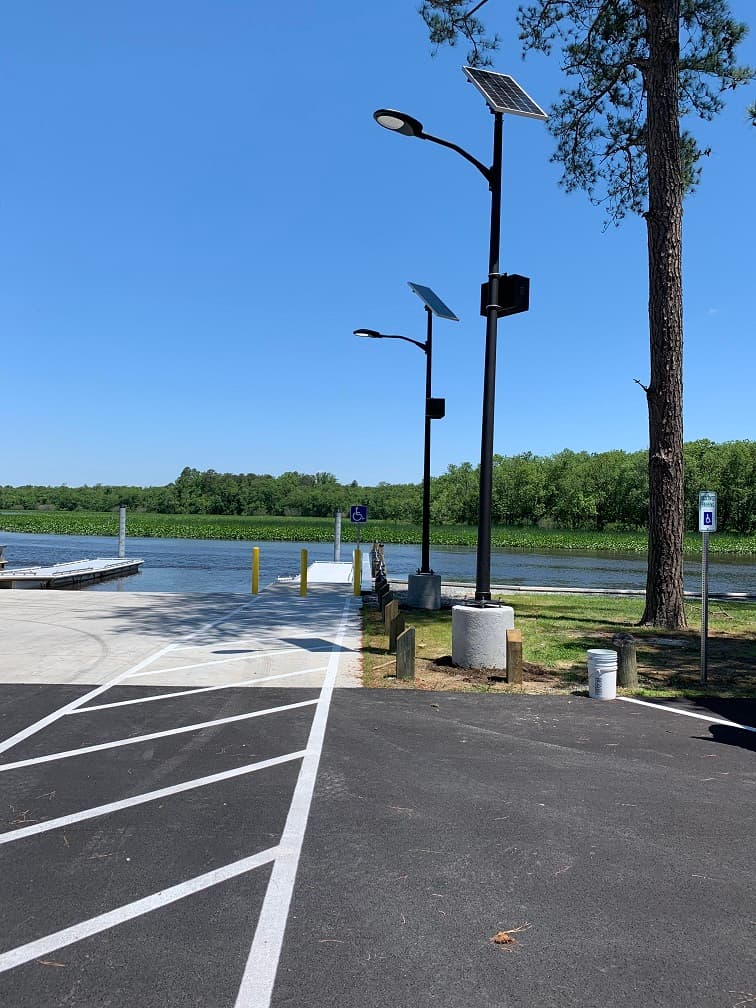
Good solar lighting design is invisible when it's done right and painfully obvious when it isn't — fixture malfunctions, uneven light spread, shortened component life, and a look that clashes with the site all trace back to design decisions made, or skipped, before installation. Here's what actually goes into a proper solar lighting design.
Sizing the System Correctly
Reputable manufacturers model a project with two 3D simulations — one showing the desired layout, one showing what the engineering actually supports — before a single pole goes in the ground. Light output for these simulations is typically measured in foot-candles, the intensity of light one foot from a single candle, though lux is sometimes used as an alternative unit for the same measurement.
The Array-to-Load Ratio
The Array-to-Load Ratio (ALR) determines how the solar panel wattage and electrical components get sized relative to each other, and it's not a fixed number — it shifts slightly year to year as panel and battery efficiency improve. Getting the ALR wrong doesn't just hurt performance; it can force an expensive system reconfiguration after the fact, which is why this calculation belongs with a qualified lighting engineer rather than a generic spec-sheet lookup.
Solar Insolation and Panel Wattage
Panel wattage gets sized against a site's solar insolation — its actual sun hours — and reputable manufacturers calculate around the winter solstice specifically, the point in the year with the least available sunlight. Designing around that worst case is what makes a system genuinely "set and forget": if it generates more energy than it consumes on the shortest, darkest day of the year, it will comfortably clear that bar every other day too.
Layout and Fixture Placement
Spacing depends entirely on what the lighting needs to serve. A roadway can tolerate wider spacing between poles than a business entrance, which needs closer, more continuous coverage. Pedestrian-heavy areas generally call for larger fixtures placed closer together than a corridor built mainly for vehicle traffic. Site obstructions matter too — trees in a park or tall buildings in a dense urban area can block a solar panel's exposure, and nearby competing light sources, like a brightly lit car dealership, can visually wash out a dimmer solar fixture nearby.
Designing Around Aesthetics
- ✓Choose a different fixture — styles like the Lita or Brighta series are designed with parks and residential settings in mind, where a utilitarian street fixture would look out of place
- ✓Wrap the panel around the pole — the Volta approach integrates the solar panel into the pole itself for a more unified look, though performance varies by site orientation
- ✓Bury the battery — placing batteries underground improves the fixture's appearance and helps regulate battery temperature, though buried batteries still need replacement roughly every five years
Compliance: Dark Sky and Color Temperature
International Dark Sky Association (IDA) compliance is increasingly a design requirement rather than a nice-to-have. It covers two things: light spill, meaning no light escaping past the fixture's 180-degree forward plane, and color temperature, capped at 3000 Kelvin for warm white output. Reputable manufacturers also follow ANSI standards for acceptable color temperature variation across LED production batches, so fixtures installed together don't visibly mismatch.
Conclusion
Solar lighting design isn't a single decision — it's sizing, layout, aesthetics, and compliance all solved together for one specific site. Getting any one of them wrong shows up eventually, whether as a fixture that looks wrong for its surroundings or one that simply can't keep up on the shortest day of the year. Greenshine's design process is built to catch all of it before installation, not after.
Professional Consultation
Fill in your project details and one of our lighting experts will get back to you within 24 hours.
Questions? Call us at 949-609-9636
Financing Available
Greenshine partnered with Balboa Capital, a top-rated direct lender, to offer fast, easy, and affordable equipment financing options.
Learn more →Related Articles
How to Size a Solar Lighting System
Sizing is a term used to describe the measurements of a solar lighting system.Here’s a brief outline on sizing a solar lighting system.
About Street Light Poles: The Foundation of a Street Light
A solar light is only as good as the pole holding it up. Here's what separates a pole built to last from one that isn't — steel grade, EPA, galvanization, and foundation depth.