How Does an LED Work?
Every solar light depends on an LED to actually produce light. Here's the physics behind how that happens, and what separates a good LED fixture from a mediocre one.
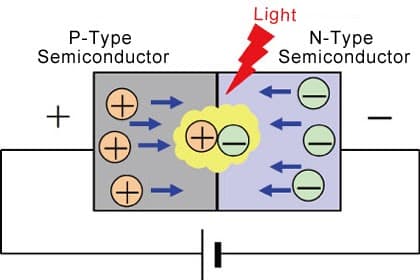
A solar lighting system spends its whole day capturing energy for one purpose: powering an LED after dark. Understanding how an LED actually produces light, and what separates a well-made fixture from a cheap one, makes it much easier to judge whether a solar light is actually built to last.
The Physics of an LED
An LED works in reverse compared to a photovoltaic cell. Inside a semiconductor sits a p/n junction, a "p" band rich in electrons and an "n" band full of electron holes. When power reaches the LED, electrons jump the gap between those bands and fill the junction points, releasing photons in a process called electroluminescence. Different semiconductor materials produce different colors of light; gallium arsenide, for instance, produced some of the earliest practical red LEDs.
Getting to White Light
Blue LEDs, the missing piece needed to produce true white light, were not invented until the mid-1990s, when professors Isamu Akasaki, Hiroshi Amano, and Shuji Nakamura developed a working blue LED using gallium nitride. Applying a phosphor layer to the LED lens converts that blue light into the white light used in most fixtures today. Efficiency gains since then have followed a pattern sometimes called Haitz's Law, a long run of exponential improvement in LED output paired with steadily falling cost, roughly analogous to Moore's Law for LEDs.
What to Look for in a Quality LED
- ✓Color temperature — ranges from about 1,000K (warm, amber) to 10,000K (cool, blue-white) on the Kelvin scale, and the right choice depends on the application.
- ✓Manufacturer track record — CREE, founded in 1987 as a pioneer in silicon carbide semiconductor compounds, is one of the reference points for LED quality in outdoor lighting.
- ✓Output and lifespan — quality fixtures typically deliver around 130 lumens per watt and run roughly 50,000 hours before dropping to 70% of original brightness.
- ✓Circuit design — parallel circuits are the better choice over series wiring, since a parallel array keeps working even if a single LED in the string fails.
Lenses Matter More Than They Look
The lens covering an LED affects both output and durability. Acrylic remains the most widely used lens material for good reason: thin, cheaper plastics warp under heat and weather exposure over time, distorting the beam pattern the fixture was designed to produce.
Distribution and Beam Angle
| Type | Lateral Width | Typical Use |
|---|---|---|
| Type I | Narrow | Sidewalks, narrow walkways |
| Type II | ~25 degrees | Wider walkways |
| Type III | ~40 degrees | Roadways, parking lots |
| Type IV | ~60 degrees | Building sides, wide roadways |
| Type V | All-direction | Large parking lots, intersections |
Beam angle follows a related but distinct scale: Spot (5-20 degrees), Flood (21-35 degrees), Wide Flood (36-49 degrees), and Very Wide Flood (50-120 degrees), and the right choice depends on whether a fixture needs to throw light far or spread it wide. Engineers evaluate both properties using a luminous intensity distribution pattern, typically plotted as a polar curve, alongside a spectral power distribution graph showing how a fixture's output is spread across different wavelengths.
Why This All Matters for Solar
None of this changes because a light happens to run on solar power rather than the grid; an LED is an LED either way. But because a solar fixture only has a fixed daily energy budget to work with, getting the LED, lens, and distribution pattern right matters even more: every lumen wasted on the wrong beam angle is a lumen that had to be captured, stored, and paid for by an undersized battery.
Professional Consultation
Fill in your project details and one of our lighting experts will get back to you within 24 hours.
Questions? Call us at 949-609-9636
Financing Available
Greenshine partnered with Balboa Capital, a top-rated direct lender, to offer fast, easy, and affordable equipment financing options.
Learn more →Related Articles
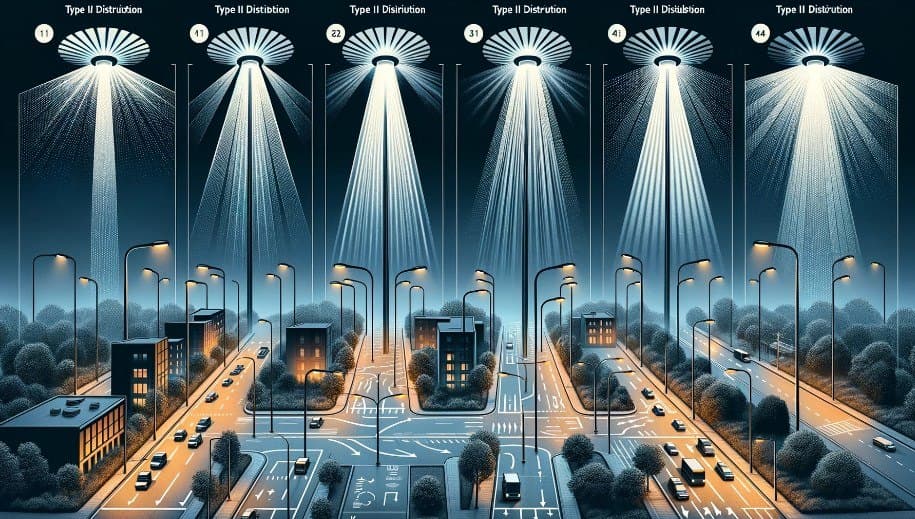
The Spectrum of Solar: Understanding Different Light Distribution Types in Street Lighting
Brightness is only half of what makes a street light effective — how that light spreads across the pavement matters just as much. Here's a rundown of the standard distribution types and where each one fits.
How Do Solar Panels Work? (3 Tips to Pick Quality Panels for Your Projects)
Nearly every solar light depends on the same basic material: silicon. Here's how a solar panel actually converts sunlight into electricity, and three ways to tell a quality panel from a cheap one.