The Spectrum of Solar: Understanding Different Light Distribution Types in Street Lighting
Brightness is only half of what makes a street light effective — how that light spreads across the pavement matters just as much. Here's a rundown of the standard distribution types and where each one fits.
Solar street lighting gets most of its attention for the energy it saves and the carbon it avoids, but one of its most underappreciated design variables is light distribution, the pattern by which a fixture spreads illumination across the ground below it. Choosing the wrong pattern for a site wastes light, leaves dark gaps, or spills brightness onto property that was never meant to be lit, so it's worth understanding the five standard types before specifying any fixture.
What Light Distribution Pattern Actually Means
Distribution is not about how bright a fixture is; it's about how evenly and purposefully that brightness spreads. A high-lumen fixture with the wrong distribution pattern can still leave a street unevenly lit, with hot spots near the pole and dark patches between fixtures.
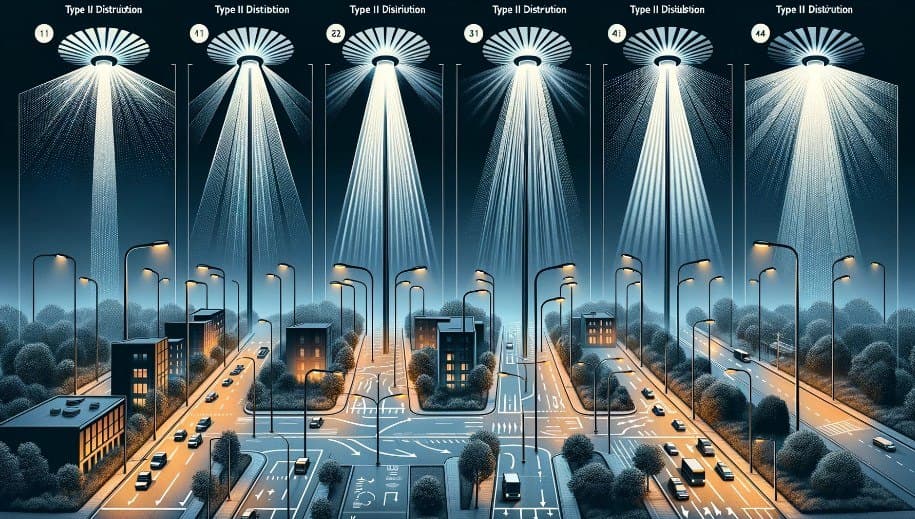
The Five Distribution Types
| Type | Best For | Pattern |
|---|---|---|
| Type I | Sidewalks, narrow streets, pathways | Bidirectional, lateral spread along a narrow corridor |
| Type II | Wider walkways, small residential roads | Wider lateral spread that avoids adjacent property glare |
| Type III | Wide roadways, parking lots, open pedestrian areas | Broad coverage suited to larger public spaces |
| Type IV | Building and wall-mounted fixtures | Forward-throwing light, common in commercial zones |
| Type V | Intersections, plazas | Circular, uniform, all-direction spread |
As a rule of thumb, Type I fits when a roadway's width does not exceed the mounting height of the fixture; wider spaces call for progressively broader types up through Type V for locations that need even light in every direction.
The Five Components Behind Every Pattern
- ✓Light source — LEDs, HID, or older lamp technologies, each with different efficiency, color rendering, and lifespan characteristics.
- ✓Luminaire — the fixture housing that actually shapes distribution through reflectors, lenses, and diffusers.
- ✓Power supply — wiring and transformers for grid-tied systems, or photovoltaic panels and battery storage for solar systems.
- ✓Control system — anything from a basic on/off switch to motion sensors, dimming schedules, and smart automation.
- ✓Mounting system — the poles, brackets, and frames that physically position a fixture for its intended distribution pattern.
Why Solar Street Lights Are a Good Match for This
Solar fixtures are increasingly designed around these same distribution standards, pairing LED optics with photovoltaic charging and, in Greenshine's case, an onboard controller that manages output automatically. The result is a fixture that delivers the right distribution pattern for its site while running entirely off-grid.
Tradeoffs Worth Knowing
- ✓Upfront cost — solar fixtures generally cost more to install than conventional lighting, though the gap narrows considerably over the fixture's lifespan.
- ✓Weather dependence — output varies with sunlight, which is why dependable battery storage matters as much as the panel itself.
- ✓Installation precision — getting the benefit of a well-chosen distribution pattern requires careful positioning and directional alignment during install, not just picking the right fixture off a spec sheet.
Getting Distribution Right
As cities keep expanding and environmental considerations carry more weight in infrastructure decisions, choosing the correct distribution pattern is quietly one of the highest-leverage decisions in any street lighting project, solar or otherwise. Get it right and a street stays evenly, safely lit for the life of the installation; get it wrong and no amount of extra brightness fully makes up for it.
Professional Consultation
Fill in your project details and one of our lighting experts will get back to you within 24 hours.
Questions? Call us at 949-609-9636
Financing Available
Greenshine partnered with Balboa Capital, a top-rated direct lender, to offer fast, easy, and affordable equipment financing options.
Learn more →