How Solar Street Lights Are Transforming Urban Areas
Two recent Greenshine installations in Montrose, Colorado, and Bakersfield, California, show exactly how solar street lighting is changing the economics of urban infrastructure.
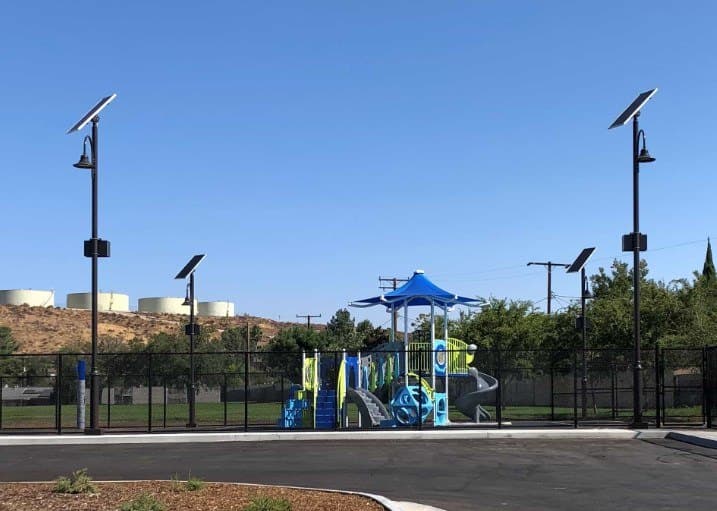
Solar street lighting is no longer a novelty for cities weighing new infrastructure — it's increasingly the default choice. By harnessing sunlight instead of grid power, solar streetlights let municipalities light new sidewalks, bike paths, and parks without the cost and delay of running electrical service to every pole. Two recent Greenshine projects, in Montrose, Colorado, and Bakersfield, California, show what that looks like in practice.
Case Study: Bakersfield, California
In Bakersfield, Greenshine installed 28 Supera solar street lights along a newly constructed sidewalk and bike path, funded in part by a grant from California's Natural Resources Agency. The Supera Series is built specifically for street-lighting duty, and it delivered exactly what the Kentucky Street project needed — better visibility along the corridor and safer, more accessible conditions for cyclists and pedestrians, all without the cost of a traditional grid-tied build-out. The project has since become something of a reference case for cost-effective green infrastructure in the region.
Case Study: Montrose, Colorado
Montrose took a smaller but equally telling approach, installing nine solar lights in Rotary Park. The city's public works department flagged two things in particular: how little disruption the installation caused, since no trenching was required, and how much flexibility they had placing wire-free fixtures exactly where the park needed them rather than where existing conduit happened to run. Montrose liked the results enough to already be planning a second nine-light phase.
Why This Keeps Happening in More Cities
- ✓Lower total cost — no electrical infrastructure to design, permit, or trench for cuts both upfront cost and project timeline.
- ✓Reduced ongoing expense — solar lighting draws no grid electricity and needs minimal maintenance, freeing municipal budgets for other infrastructure priorities.
- ✓Better public safety — well-lit streets, parks, and paths measurably reduce accident and crime risk, and solar fixtures stay lit through power outages when other infrastructure goes dark.
- ✓Genuine flexibility — fixtures install almost anywhere, including previously hard-to-reach corners of a park or a bike path that would be prohibitively expensive to wire conventionally.
- ✓Lower environmental footprint — eliminating grid draw for outdoor lighting reduces a city's reliance on fossil-fuel generation and the associated emissions.
Built to Handle Real Conditions
None of this works if the fixtures can't handle actual weather. Greenshine's street lighting systems are engineered for extreme heat, cold, and storm conditions, and because each pole operates independently of the grid, a city's most critical lit areas — crosswalks, park entrances, transit stops — stay illuminated during the exact outages when lighting matters most.
A Model Other Cities Are Already Following
Montrose and Bakersfield are not outliers; they're a preview. As more public works departments see the combination of lower cost, faster installation, and continued operation through outages, solar street lighting is shifting from an experimental pilot to a standard line item in urban infrastructure planning — one trenching-free project at a time.
Professional Consultation
Fill in your project details and one of our lighting experts will get back to you within 24 hours.
Questions? Call us at 949-609-9636
Financing Available
Greenshine partnered with Balboa Capital, a top-rated direct lender, to offer fast, easy, and affordable equipment financing options.
Learn more →